2 templates available
Showing 2 of 2 templates

You've reached the end of all templates
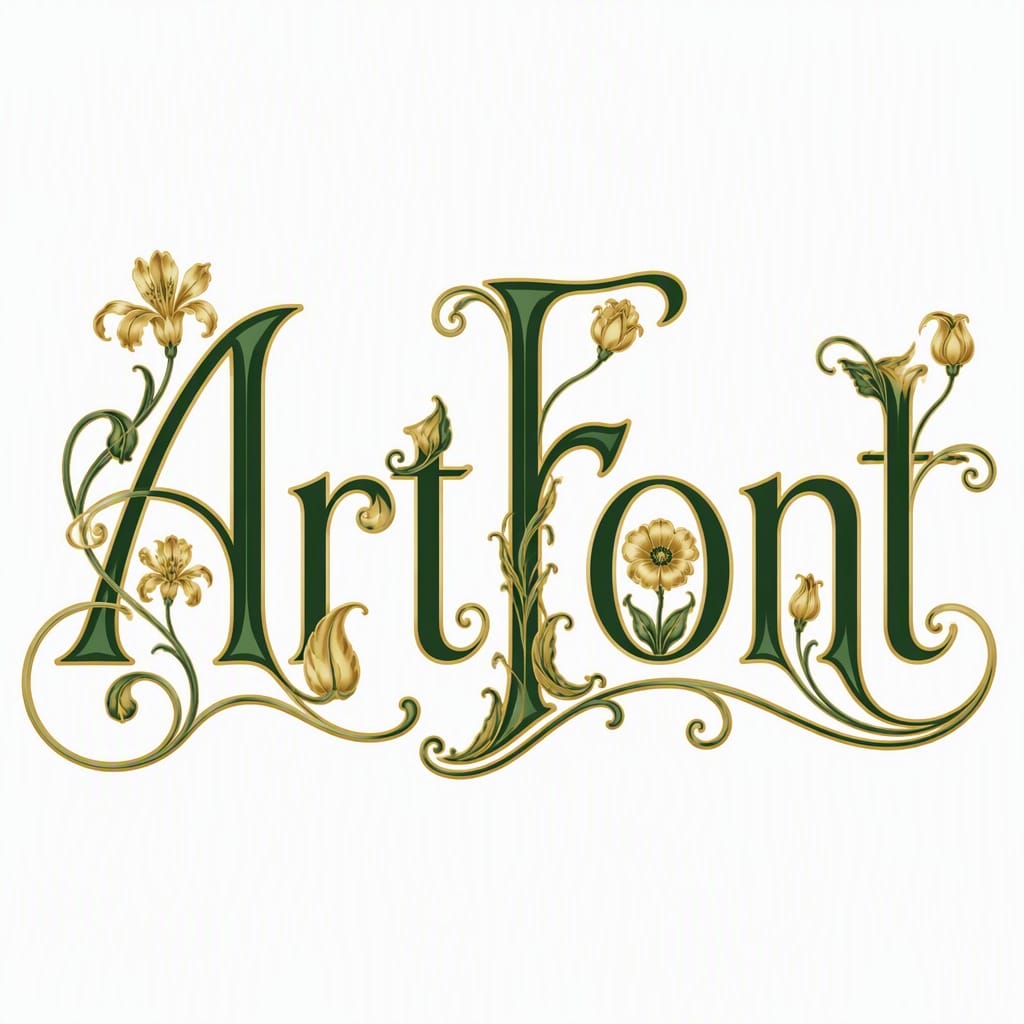
Organic floral lettering — Belle Époque & botanical decorative art
Design breathtaking Art Nouveau typography with our AI art font generator. Drawing from the Belle Époque tradition of organic curves, botanical vine ornaments, and sinuous line art, these templates are perfect for luxury lifestyle brands, beauty and wellness packaging, event invitations, editorial design, and any creative project inspired by the ornate elegance of 1890s–1910s European decorative art.
Art Nouveau typography emerged in Western Europe between approximately 1890 and 1910 as part of the broader Art Nouveau design movement, which rejected industrialism in favor of natural organic forms. In lettering, Art Nouveau is characterized by sinuous curved letterforms, botanical ornaments (vines, flowers, insects) integrated into or surrounding the text, asymmetrical compositions, and flowing line quality inspired by natural growth patterns. Key practitioners include Alphonse Mucha, whose poster lettering defined the Belle Époque aesthetic, and Hector Guimard, designer of the Paris Métro entrances. The style is immediately recognizable by its combination of elegance and organic complexity.
ArtFont's Art Nouveau templates use AI to generate the organic curved letterforms and botanical ornamental details that define the style. The Art Nouveau Floral template integrates vine and floral elements directly into the letterforms. The Belle Époque template produces a cleaner, more refined script interpretation suited for sophisticated applications. Both are generated via text prompt in 10–30 seconds — the AI has learned the characteristic sinuous line quality, botanical motif vocabulary, and period-appropriate proportions from extensive Art Nouveau reference material.
Art Nouveau typography excels in luxury and lifestyle applications where organic elegance is the desired aesthetic: beauty brand packaging and cosmetics (particularly botanical skincare lines), wellness and holistic health brand identities, fine wine and spirits labels, fashion and jewelry brand typography, editorial spreads in lifestyle magazines, wedding and event stationery for nature-themed celebrations, restaurant and café branding with a European heritage positioning, and any creative project that benefits from the Belle Époque association with sophisticated European culture and craftsmanship.
No — Art Nouveau and Art Deco are distinct movements from different eras with opposing design philosophies. Art Nouveau (1890–1910) drew inspiration from natural organic forms: sinuous curves, botanical ornaments, asymmetry, and flowing lines. Art Deco (1920–1940) reacted against Art Nouveau's organic complexity with geometric precision, symmetry, angular forms, and machine-age modernity. In typography, Art Nouveau produces curved, vine-like letterforms; Art Deco produces clean geometric letterforms with bold angular details. Both are associated with luxury and European design excellence, but they represent fundamentally different aesthetic visions.
2 templates available